Twenty+ Jade Lanterns: Inside the Quietest Week of the Season
Twenty Jade Lanterns: Inside the Quietest Week of the Season
Greetings, fellow wranglers!
This weekend at the Pinckard Monarch Butterfly Ranch, the ceiling of Habitat Two has gone still.
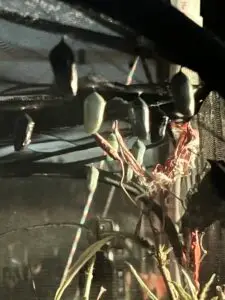
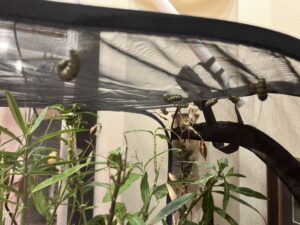
Last weekend, I wrote about silk buttons and J-positioned caterpillars and the first few chrysalises forming on the screen. Seven days later, almost every one of those caterpillars has finished what it set out to do. Twenty-plus jade chrysalises now hang from the inside of Habitat Two, in loose clusters and singles, each one no longer than a thumbnail and each one holding everything the next monarch will need.
The habitat is the quietest it has been in weeks.
Here is what the weekend looks like from inside the ranch.
A Canopy of Twenty
Stand in front of Habitat Two right now and the first thing you notice is the ceiling.
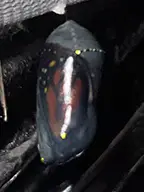
Where there used to be motion — caterpillars climbing, leaves swaying, silk buttons being laid down — there are now only the chrysalises. Twenty-plus of them, hanging in loose constellations across the screen. Jade-green. Smooth-walled. Each one ringed with a faint band of gold dots near the top, like a crown.
They look identical at a glance. Look longer and the differences come in. Some are older — the green a little deeper, the gold slightly more pronounced. Some are newer — still slightly soft-looking, the surface not yet fully hardened. None of them is darkening yet. That comes later, in their final twenty-four hours, when the green gives way to slate and the orange-and-black of the folded wings begins to show through.
For now, every one of them is doing the same thing.
What Is Happening Inside
The chrysalis is the part of the life cycle that looks the most like nothing is happening and is actually the part where the most is happening.
From the outside, a monarch chrysalis is a still, jade-colored shell. It does not move. It does not eat. It does not breathe in a way you can see. For about eight to fourteen days, depending on temperature, it simply hangs.
Inside that shell, the caterpillar that climbed up the screen a few days ago is not really a caterpillar anymore. It is being unmade and remade at the same time.
Most of the caterpillar’s body has dissolved into a kind of organized soup, Monarch Mash. Floating inside that soup are small clusters of cells called imaginal discs, which the caterpillar carried with it all along, hidden beneath its skin. The imaginal discs are the blueprints for the butterfly. There is a disc for each wing. A disc for the antennae. A disc for the legs the butterfly will land on. A disc for the proboscis it will use to drink nectar.
Over the days the chrysalis hangs, those discs grow. They feed on the dissolved tissue of the caterpillar that was. They build wings where there were none. They lengthen into legs. They form a mouth designed for nectar instead of leaves.
By the time the chrysalis darkens and emergence is near, there is no caterpillar left inside. There is a butterfly, folded tightly, waiting for the shell to split.
It is the strangest, most beautiful thing in our hobby. And it is happening right now, twenty-plus times over, on the ceiling of Habitat Two.
Counting What the Wave Brought
Two weekends ago I wrote that Habitat Two had more than twenty-five caterpillars in early instars. This weekend it has twenty-plus chrysalises. The numbers are close, and not by accident — but they are not identical either.
A few caterpillars did not make the climb. That is part of every wave. Some never finished their last molt. One or two went sluggish in a way I have learned to recognize as tachinid presence. A couple wandered off the milkweed and did not find their way back. It is a sober part of the season, and it is honest to say so.
What made it across is what is hanging on the screen right now. Twenty-plus monarchs in the most concentrated form they ever take — small, sealed, and on their way.
The Wrangler Steps Back
This is the week the wrangler does almost nothing.
For the first time in the wave, the milkweed is not being eaten. There is no frass to clear. No instars to count. No leaves to rotate. The self-watering reservoir is keeping the potted plants alive without any input from me, even though no caterpillar is feeding on them at the moment. The lights come up and go down on their schedule.
The chrysalises do not need handling. They do not need misting. They do not need turning. They do not need to be moved. They need exactly one thing from me: to be left alone.
The minimum-interference principle that runs through everything I do at the ranch and through Rescue, Raise, & Release is at its purest in this week. There is nothing useful the wrangler can add by reaching in. There is plenty the wrangler can disturb by reaching in. So I keep my hands out of the habitat, watch through the screen, and let the wave finish what it started.
It is the part of the season that asks the wrangler to trust the work that has already been done.
Habitat One: Clean and Waiting
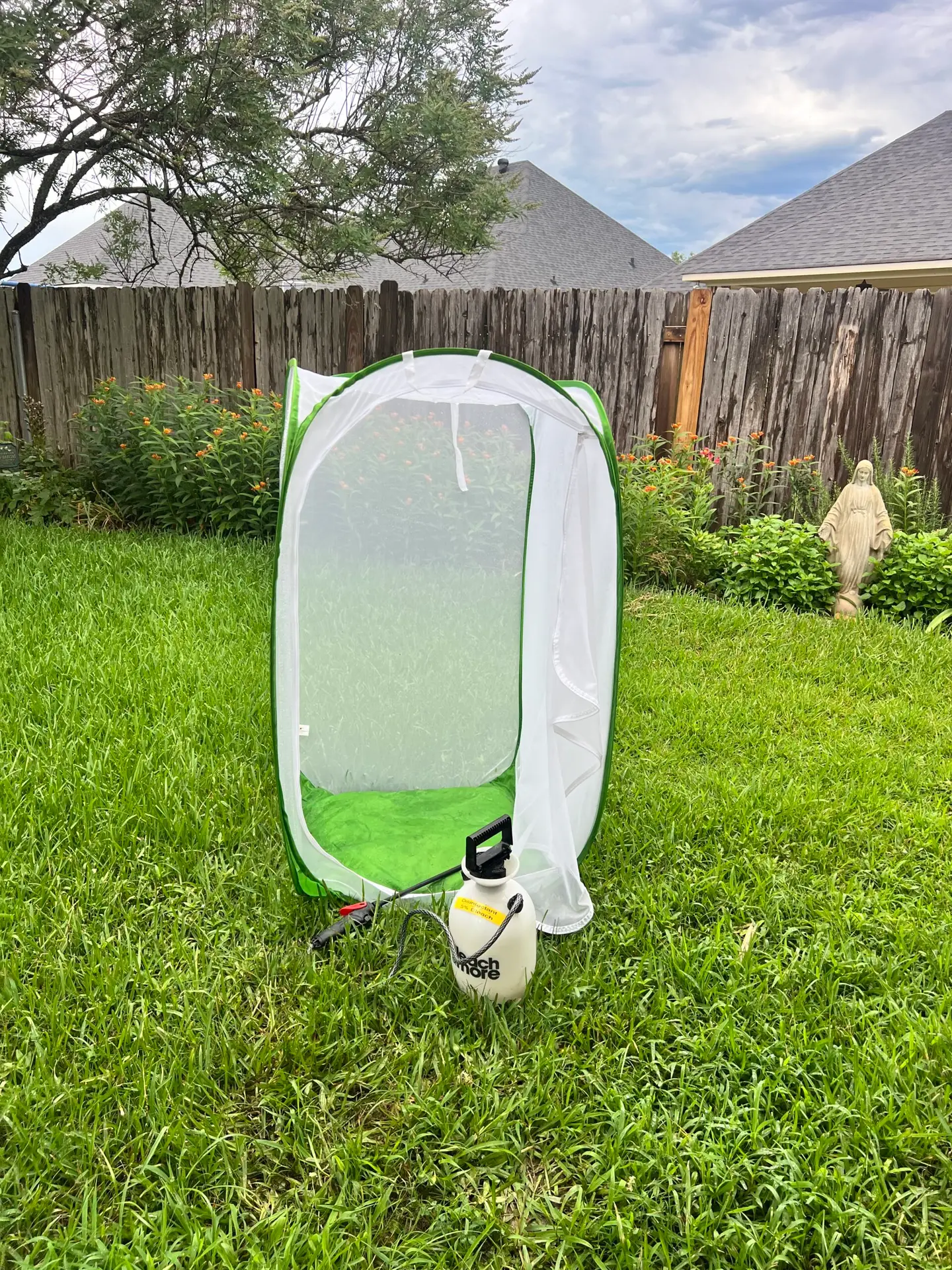
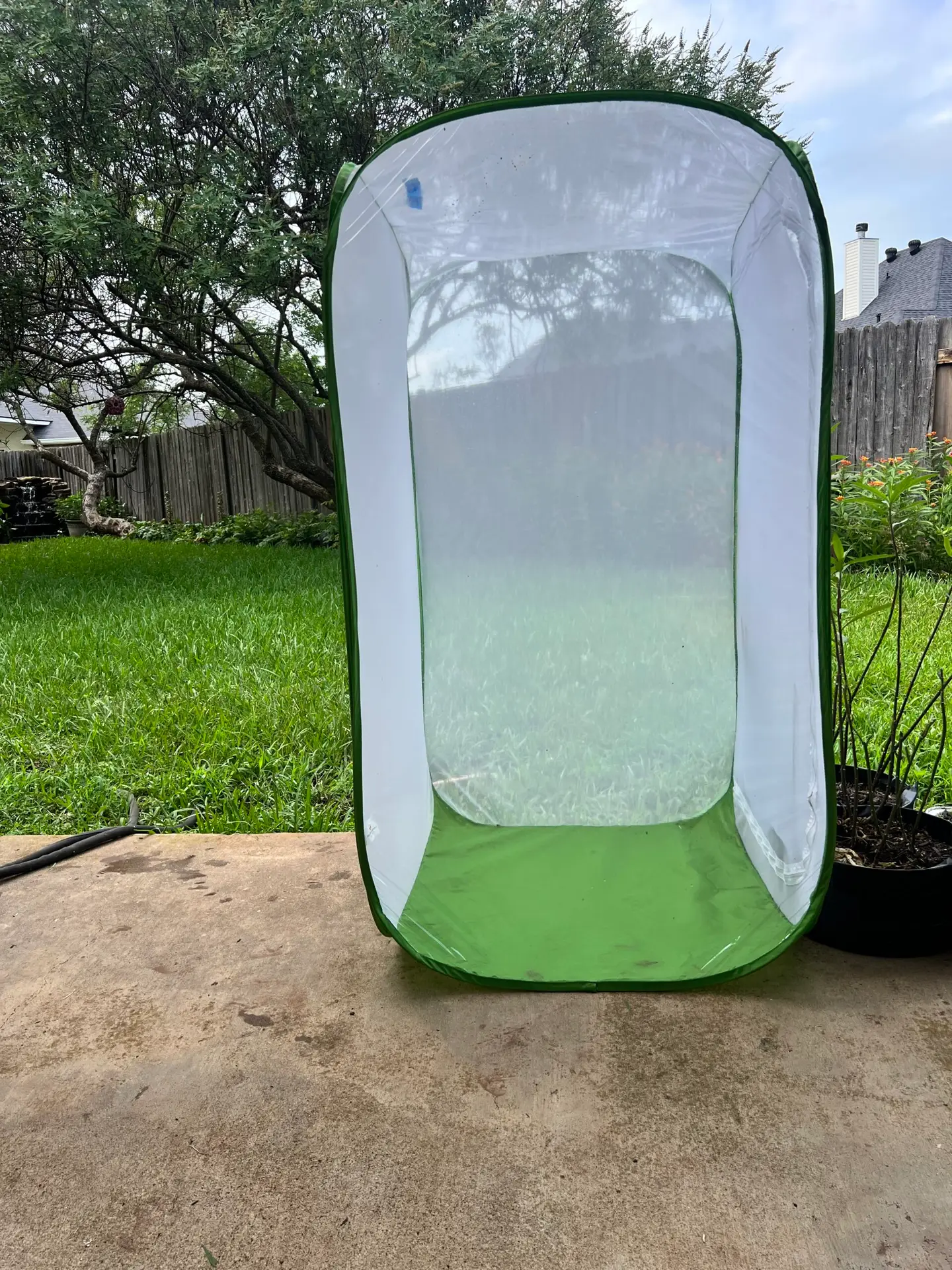
In the next room, Habitat One sits clean, dry, and empty. It has been scrubbed, bleached, rinsed, and sun-dried since last weekend. The screen is spotless. The frame is bare. Nothing has been moved in or out.
It is held in reserve — ready for whatever wave comes through the waystation garden next. Eggs found on milkweed leaves. Tiny instars rescued from the flowerbed. Whatever shows up first.
For now, it waits.
The Sun Inside, Still Running
The programmed LED day keeps running on the same schedule it has run all season. Sunrise at seven. Full midday by ten. Sunset starting at five. Nightfall at seven-thirty.
The chrysalises do not need light to develop, but they do need consistency. The day-night cycle inside the habitat lines up with the day-night cycle outside, which means that when the time comes for emergence, the new butterflies will break their shells into a familiar pattern of light and dark — the same one they would have known if they had pupated outdoors.
Consistency is the whole point. Even when nothing else is happening, the sun keeps rising.
The Wrangler’s Job This Weekend
One routine, very short.
- Visual check morning and evening.
- Scan each chrysalis for color, position, and condition.
- Watch for any that have detached or fallen (rare, but worth a daily look).
- Do not touch the screen.
- Do not move anything.
- Let the wave hang.
For the Reader at Home
If you have raised monarchs in your backyard this season and have found chrysalises on your porch, your fence, your tomato cage, or anywhere else a caterpillar wandered to pupate — leave them where they are.
You may not see anything happening for a week or more. That is normal. The chrysalis you are looking at is performing the most dramatic act in the entire monarch life cycle, in complete silence, behind a one-millimeter wall of green.
When the wall begins to darken and you see the orange-and-black of folded wings showing through, you are inside the last day. Watch closely if you can. Emergence is fast. Within an hour or two of breaking, the butterfly will have pumped fluid into its wings, extended them to full size, and begun the long process of drying them in the open air.
Until then, the chrysalis asks for nothing.
Closing the Day
Standing in front of Habitat Two this weekend, the ranch feels paused.
Two weekends ago, the habitat was full of motion — caterpillars in every direction, milkweed disappearing leaf by leaf, the morning route taking real time. Last weekend, the motion went vertical and slowed down — silk buttons, J-positions, the first chrysalises. This weekend, the motion has stopped entirely. Twenty-plus jade lanterns hang on the screen, doing what looks like nothing and is actually everything.
The next time you read a post from this ranch, those lanterns will be darkening. After that, they will be wings.
If you are raising monarchs at home this season, tag your habitat photos #MonarchButterflyWrangler. I would love to see your hanging gallery.
Flutter and Float with the Monarchs.
Wrangle the Wonders